Binge-Watching Turn: Washington’s Spies Review

Well, my dear readers, I am writing at a furious pace to tell you about a series I have been binge-watching. It’s called Turn: Washington’s Spies, and I’ve watched Series 1 and 2 to date. It definitely gets five stars from me.

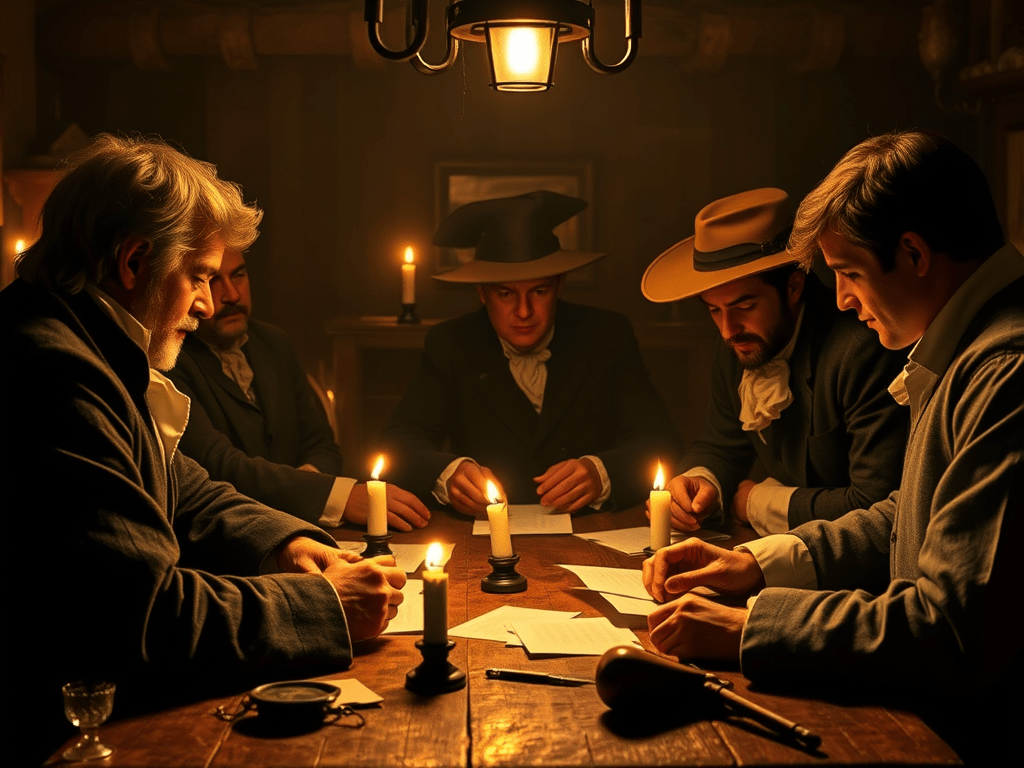
The series spans the events from 1776 to 1781 and features Abraham Woodhull, a farmer from Setauket, New York, and his childhood friends. They form an unlikely group of spies called the Culper Ring, which eventually helps to turn the tide during the American Revolutionary War. The series begins in October 1776, shortly after British victories, recapturing of Long Island and the Port of New York for the Crown, leaving General George Washington’s army in dire straits.

The show is based on a true story, but fictionalized. The costumes and attention to detail immerse you in the time period.

Season One’s greatest strength is its patient, immersive storytelling. Rather than rushing headlong into espionage theatrics, Series One takes time to establish Setauket as a lived-in community, making the risks of spying feel personal and devastatingly real. The show captures the moral ambiguity of the era: loyalties are divided, neutrality is dangerous, and survival often requires compromise. The often testy relationship between Abraham, and his father is a microcosm of what’s happening in the nation overall. This slow-burn approach pays off by grounding the suspense in genuine human stakes rather than spectacle alone.

The pace in Series Two goes up a notch as things start to become critical for both the spies and the Continental Army.

The best thing about the show is the various characters. My favorite one is Simcoe, a psychopathic British officer who keeps both the sense of threat and intrigue running high.

Running a close second is Anna Strong, who is a spy and at the start, runs the local public house. Her perceived main contribution in the ring was to relay signals to a courier who ran smuggling and military missions for General George Washington. She has a complex, fluid relationship with Abraham, and plays a vital role in what is achieved.

What more can I tell you? It’s currently on Netflix.

Exploring _The Salt Path Scandal_: A Review

Well, readers, I watched this gem on Sky earlier. The first few minutes revisit what had been a best-selling book, later turned into a starring Gillian Anderson.

The show lulls you into a tranquil daze. There are drone shots of cliffs that look like they’ve been photoshopped by the concept of serenity itself. Gentle strings hum. Someone says something earnest about “healing.” You exhale. It’s about a 650-mile walk you can do in the South West of England as told by Raynor Winn. She had just lost her house, and her husband was diagnosed with a terminal illness. The walk was transformative.

And then—record scratch—a talking head appears to ask a question so sharp it could open tinned beans: “But did that actually happen?” From there, The Salt Path Scandal becomes less a journey and more a brisk hike through footnotes.

The documentary’s true star is its tone, which can best be described as polite British skepticism wearing a fleece. Nobody yells. Nobody lunges. Instead, the filmmakers deploy the deadliest weapon in the national arsenal: calm, persistent follow-ups. “Just to clarify,” a narrator says, with the menace of a librarian about to revoke privileges. Every “just to clarify” lands like a small pebble in your shoe—annoying, impossible to ignore, and increasingly painful over time.

You see, the book claimed to be a memoir. Like, it was supposed to be true. But once, a journalist, Hadjimatheou, probed a bit. Well, there were reasons to be skeptical.

Structurally, the series is a masterclass in pacing. Each episode introduces a claim, lets it bask in sunlight, then quietly rotates it to reveal a price tag, a date discrepancy, or a witness who remembers things… differently. It’s less gotcha journalism and more hmm, interesting journalism,

By the finale, you’re left amused, mildly scandalized, and deeply suspicious of any memoir. The truth is out there somewhere.

It gets four stars out of five from me.

Have you seen it? Let me know what you think.

Festive Updates: My Creative Projects in Progress

Hi everyone, I hope you are all enjoying the festive spirit. Personally, I love this time of year and having some time off. It’s great to catch up with people, also.

I like giving these updates every six months or so on all my projects. Occasionally, these posts prove really popular. Other times, I’d be lucky if anyone apart from myself reads it at all. Such is life, I guess. First, an update on my longer-term projects.

Wheelchair Wars

This has now been fully critiqued. I am about to employ a successful author to read through it to see how it could be improved. I’m aiming for the stars.

Romance Short Stories

Critiqued, but I need to work through the suggestions and rewrite as appropriate. Hopefully, this will be significantly improved over the holidays

Pegasus

The first draft is complete; the next needs to go through the critique process.

Distant Love

First draft being written.

The blog itself is going quite well. Last year, it received 1,746 views. It’s looking like this year will be more like 2,746. Still, quite a way to go to become profitable, but moving in the right direction.

I have 2,700 followers on Bluesky. Hoping to get that up to the 5k range by next year.

Plenty of things planned for next year, and hopefully, see you there!

Exploring Football’s Greatest Con: King of Lies Episode 1

Hello, my dear readers. Took an annual leave today and decided that it was important for it not to be wasted. So, I watched TV and the above documentary, in particular.

Episode 1 of King of Lies: Football’s Greatest Con launches the series with an enticing blend of mystery and tension, but it’s not without its stumbles. The premiere does a solid job establishing the central scandal, which revolves around the sale of Notts County Football Club (the oldest professional football club in the world), teasing just enough information to pique curiosity without revealing too much too soon. The opening sequences are atmospheric and stylish, setting a tone that’s equal parts investigative thriller and sports documentary.

The documentary’s greatest strength is its interviews. I was stunned to see Sven-Göran Eriksson pop into the story. The interview is from the depths of sickness shortly before he died. Unfortunately, he gets caught up in it all and quite bizarrely ends up in North Korea at one point!

However, the pacing is noticeably uneven. Some sections feel stretched out, lingering on details that don’t yet carry emotional or narrative weight. The editing sometimes jumps abruptly between timelines or perspectives, which can make the episode feel scattered,

Russell King is the conman leaving ruin wherever he goes. It’s quite a complex con, almost masterful. But it’s impossible to see his out. He needed the con or new cons to keep being successful, to not get caught.

An interesting documentary. I learned that you can’t get people to do what they don’t want to. The art of persuasion is giving them a reason to do what they want.

Yes, so, not sure if that’s a positive, but what the hell.

It gets three stars out of five from me.

Have you seen it? What do you think?

Episode 1 of King of Lies: Football’s Greatest Con is currently available on Sky Documentaries.

A Review of Netflix’s ‘Being Eddie’: Insights and Reflections

Anybody within seven or eight years of my age (I’m forty-six) would have fond memories of Eddie Murphy. I still remember seeing Beverly Hills Cop for the first time. A great film that would never have made it without him. It was the first time I saw on-screen a black character who was clearly more intelligent than the white people around him. All the curses stuck out as well.

But what happened to him recently? I haven’t heard his name in an age. I was also interested in what other aspects of his life were like.

That’s why I watched the documentary “Being Eddie” on Netflix a couple of nights ago.

If you are looking for something visceral, raw, then this is not it. Some critics think it’s more like a prelude to him returning to stand-up more than anything else. It retreats from anything awkward/contentious. He comes across as a family man and reminisces about voicing the donkey in Shrek. There is nothing about the paternity suit with Mel B, for example. He has ten children. Musk would be proud.

The best part is when it just lets him speak. I found his tendency towards OCD intriguing. Great minds appear to have a likelihood for such things, and I doubt it’s a coincidence.

He also brings up that he has never won an Oscar, despite his great performances and sometimes playing multiple characters in the same film. I wouldn’t worry about it if I were him; their value has greatly diminished over the years.

The interviews with other comedy legends, Dave Chappelle, Chris Rock, Jerry Seinfeld, Kevin Hart, and more, show what a powerful influence he was on the industry. They all say nice things. What a pity!

I give it three stars out of five. It’ll make you feel warm. Just don’t expect anything beyond the bland, though.

Have you seen it? Let me know what you think.

Netflix’s The Last Czars: Drama, History, and Flawed Royals

Well, let’s face it. Russia is fairly topical at the moment. But how did we get here? Well, any story about Russia has to include the Romanovs, who ruled for 300 years. The Last Czars is an ambitious attempt by Netflix to blend historical documentary with dramatized storytelling, chronicling their downfall —and the rise of the Bolsheviks. The result is an intriguing, visually lavish production that succeeds in moments but often struggles to find its identity.

The lavish costumes, ornate set designs, and snowy Russian landscapes evoke the grandeur—and isolation—of the Romanov dynasty. The performances, especially Robert Jack as Tsar Nicholas II and Susanna Herbert as Alexandra, bring depth to historical figures often seen as symbols rather than people. And rather flawed people they turn out to be.

At times, I felt sympathetic to their plight as their Empire collapsed around them. Other times, not so much as they make one poor decision after another. The Bolsheviks shouldn’t have shot the children, but Nicholas II and Alexandra cared little for the ordinary Russian. It reminds me of someone, I can’t quite put my finger on it.

The most interesting character is, of course, Rasputin. He is someone I have always been interested in. A religious man. God saves sinners; therefore, it is important to sin. Only then can you ask for forgiveness. He tries his best to drink and to make love to as many women as possible. God bless, he loves his God. The Romanovs fall under his spell, a sick son creating a wedge between them and their people (well, she’s German, it’s complicated).

The inclusion of documentary-style narration and expert interviews gives the viewer valuable historical grounding. However, this same hybrid format is also the show’s greatest weakness. The constant switching between drama and documentary can feel jarring, breaking immersion and undercutting any attachment to what is happening.

Personally, I found it a bit of a struggle to keep watching. Three stars out of five for me. If you’re committed to hours of TV every day, give it a try. If time is precious, there is much better out there.

But let me know what you think? Have you seen it?

Heaven’s River: A Review of the Latest Bobiverse Adventure

Hello, dear readers, I finished reading this novel by Dennis E. Taylor last night. It is the fourth book in the Bobiverse series. I have reviewed the others previously and given them strong reviews. But what of this one?

Well, dear readers, to fully appreciate each novel, I recommend reading them in order. It’s a big Universe after all, and so many stories to be told.

The Bobs are copies of the digitally stored personality of a dead human (“Bob”), carried in self-replicating Von Neumann probes. The original mission to explore new worlds was originally tied to saving humanity.

With each replication, there is a drift from the original personality. At this stage, some bobs are the thirtieth generation or more. This has led to factions forming within the Bobiverve, such as Star Trek and the Skippies.

Starfleet believes that the Bobiverse should cease its interaction with biologicals, especially those that don’t engage in space travel, calling it the Prime Directive.

The Skippies want to build a superintelligent AI from scratch.

Each new Bob replicant has an individual name. One of them, Bender, hasn’t been heard from in a very long time. More than a hundred years ago, Bender set out for the stars and was never heard from again. There has been no trace of him despite numerous searches by his clone-mates. Now Bob is determined to organize an expedition to learn Bender’s fate—whatever the cost.

Bob (more or less the original) goes on the same journey where he picks up an alien signal. He deduces that Bender would have followed it. It leads to the discovery of a giant megastructure – rivers that encircle a star. Inside, live a pre-steam civilization, the Quinlans.

The discovery creates a stir throughout the Bobiverse. Starfleet believes that the Quinlans should be left alone, citing the Prime Directive, but Bob would never stop his search for Bender.

It leads to war in the Bobiverse and an epic journey through a truly new world.

I give “Heaven’s River” five stars out of five. Although long, it engages from start to finish. You meet interesting new characters and catch up on old ones. It is very immersive, allowing you to fully engage with the new Quinlan civilization. It has the necessary reveals and plot twists to keep the reader going.

Have you read this novel?

Let me know what you thought in the comments.

Exploring Human Evolution in BBC’s ‘Humans’

Hello everyone. I hope you are all having a good weekend. I know I am. My plan was to finally finish Wheelchair Wars (some day soon, I promise), but as is quite usual for my good self, I got distracted. One of my distractions, other than watching the Lions getting slaughtered by Australia was setting eyes on the above BBC series, called “Humans” presented by the wonderful (and quite pretty) paleoanthropologist Ella Al-Shamahi. It details how humans have evolved and dispersed over the last three hundred thousand years, as well as the demise of our sister species (unless you’re an alien reading this in which case I’d like to remind you to please like, share and subscribe) Neanderthals, Denisovans and the human hobbits Homo floresiensis.

What does it mean to be human? Is it the way we look that is important?

These questions are asked and an answer is given.

It is clear that modern humans did not appear all at once but more gradually. It also states that East Africa was only one pocket among many others across Africa where humanity developed. It makes clear that our intellect and ability to change our behavior is what sets us apart.

A criticism though about its portrayal of the extinction of the Neanderthals. It never explicitly stated that although they covered a wide range, their population was always low even at its height, with possible as few as three thousand breeding pairs. So, although they persisted for hundreds of thousands of years, they always lived close to the edge. The fact that human pathogens might have killed them off was never mentioned.

No comment was really made on how they were probably not our intellectual match. Their groups were far smaller, and they were more heavily dependent on kinship lacking the Machiavellian intellect that is theorized to be required for larger groupings .

It did make clear that the second wave of humans (the first wave failed) were far more advanced and better able to thrive in the harsh conditions.

I recommend you give it a watch.

A Deep Dive into Arthur C Clarke’s Childhood’s End

Well, readers, I have a treat for you today after I completed the above novel that was written in nineteen fifty-seven by what is considered to be one of the best science fiction writers of all time. This is considered by most to be his greatest work.

First, a description from Wikipedia (in italics) that I’ve read and agree with.

In the late 20th century, the United States and the Soviet Union are competing to launch the first spacecraft into orbit when alien spaceships suddenly position themselves above Earth’s principal cities. After one week, the aliens announce they are assuming supervision of international affairs, to prevent humanity’s extinction. They become known as the Overlords. In general, they let humans go on conducting their affairs in their own way, although some humans are suspicious of the Overlords’ benign intent, as they never allow themselves to be seen.

Yeah, remember the Soviet Union? They were a big deal back then.

The Overlord Karellen, the “Supervisor for Earth”, periodically meets with Rikki Stormgren, the Secretary-General of the United Nations. Karellen tells Stormgren that the Overlords will reveal themselves in 50 years, when humanity will have become used to their presence. When the Overlords finally reveal their appearance, they resemble the traditional Christian folk images of demons, with cloven hooves, leathery wings, horns, and barbed tails. Humankind enters a golden age of prosperity at the expense of creativity.

The Overlords are interested in psychic research, which humans suppose is part of their anthropological study. Rupert Boyce, a prolific book collector on the subject, allows one Overlord, Rashaverak, to study these books at his home. To impress his friends with Rashaverak’s presence, Boyce holds a party, during which he makes use of a Ouija board. Jan Rodricks, an astrophysicist and Rupert’s brother-in-law, asks the identity of the Overlords’ home star. The Ouija board reveals a number which Jan recognizes as a star-catalogue number and learns that it is consistent with the direction in which Overlord supply ships appear and disappear. Jan stows away on an Overlord supply ship and travels 40 light years to their home planet.

The story then continues to reveal that humans are about to make a psychic leap, which will elevate humanity to a new level of existence, allowing it to join the Overmind, but also lead to the end of humans as an independent race.

So what did I think? Well, it was interesting what the author conceived a future alien species would be like. There is no advanced robotics, and only a brief mention of computers that can do wondrous things. Although they are still described as mostly mathematical tools.

Credence is given to the supernatural. This is something that the author quasi-believed at the time but later disavowed. Still, it helps the story come along.

The character development and writing are of the highest quality, and it is refreshing to read something from a nineteen-fifties perspective. You should give it a read.

On a more negative level, the passing of time shows. So, you have to put things we know now out of your mind and use some imagination.

Overall, I’d give it four stars out of five.

Remember to subscribe if you like my content, and chat with you all again soon.

My Journey as a Writer: Updates and Goals

Hello, dear readers, I hope you are all doing well. A quick reminder to consider subscribing to the website to be kept fully updated. It really is the best way.

So what have I been up to? Well, not too much in the last day or two (I’m so lazy). Before then, I did make some steady progress.

Wheelchair Wars – The reworking is almost complete of my far future dystopia, where people with disabilities are forced to fight to the death for entertainment. I’m hoping to have it published (probably self-published), but I’ll try to look for an agent in the new year. I joined an online writing group, and I think I have significantly improved my writing skills. Like everything I do, I will always endeavor to improve.

Pegasus – This action-packed story set hundreds of years in the future recently came to an end. Like Wheelchair Wars, it will be reworked and published at a future date.

Distant Love – I only started this recently. It is still easy to find Part 1. This is my latest story – a sci-fi romance. I’m still working this one out in my head, not sure how long it will be.

General Overview:

I am on track to get a record number of views this year. I’m hoping to break the 2,000 mark. From research, to be a professional blogger would need an absolute minimum of 24,000 views per year. I’m a long way off, but not beyond the realms of impossibility to do it in a few years.

I now have 1,400 followers on Bluesky. My plan is to try and get over 2,000 by the end of the year. Then drive that audience towards here, along with my Twitter and Facebook followers.

Please don’t be afraid to comment. It would be great to have some feedback.