Review of Dhurandhar: A Gripping Thriller Experience

My dear readers, earlier today, I watched the highest grossing hindi film of all time. It exceeded all of my expectations. A grandiose three-and-a-half-hour tale of gangsters and spies set in Pakistan. Yes, that is long. I don’t know what happened to films becoming shorter due to our reduced attention spans. That joke is on us.

It is written, co-produced, and directed by Aditya Dhar. It is produced by Jyoti Deshpande, Aditya Dhar, and Lokesh Dhar under Jio Studios and B62 Studios. The film features an ensemble cast including Ranveer Singh, Akshaye Khanna, Sanjay Dutt, Arjun Rampal, and R. Madhavan, alongside several supporting actors.

Serving as the first instalment of a two-part film series, it centres on a high-stakes covert counter-terrorism operation. The film follows a very sexy undercover Indian intelligence agent (hey that’s what the men say in the film) who infiltrates Karachi’s criminal syndicates and political power structures in Pakistan in an effort to dismantle a terror network targeting India.

The level of violence and threat is high. It is not for the faint-hearted. It is a fictional story that weaves in real events beautifully..

Dhurandhar is a gripping cinematic experience that balances scale, emotion, and intelligence with impressive confidence. From the very first frame, the film pulls you into a world driven by ambition, strategy, and moral complexity, and it never loosens its grip.

One of the film’s greatest strengths is its storytelling. The narrative unfolds with patience and purpose, layering tension and intrigue rather than relying on shortcuts. The screenplay is sharp and purposeful, allowing key moments to breathe while steadily building momentum. Every turn feels earned, and the film rewards viewers who pay attention to its subtleties and underlying themes.

Five stars out of five from me. All hail Netflix.

Exploring Humanity in _The Great Flood_: A Film Review

One of the best things about Netflix is that you get to watch films and documentaries from all over the world. One such film is The Great Flood from South Korea. It was co-written and directed by Kim Byung-woo.

An-na, an AI researcher and recent widow, played by Kim-Da-mi, wakes in her apartment to find floodwater rising in the thirty-floor complex. With her six-year-old son Ja-in, she attempts to reach safety.

However, they are no ordinary mother and child. The child is a robot designed to experience emotion. This is critical to the whole film. An asteroid has hit, and human extinction is imminent. World governments knew what was going to happen and funded secret efforts to survive, including a space station and research into the creation of engineered human bodies and consciousness. An-na’s employer is also revealed to be involved in these projects, putting her and her child central to humanity’s future.

What stands out most is the film’s balance between scale and humanity. While the flood itself is rendered with striking visual power—ominous skies, rising waters, and carefully staged moments of chaos—the story never loses sight of the people caught within it. The narrative lingers on personal choices, moral dilemmas, and quiet acts of courage, allowing the disaster to feel not just catastrophic, but deeply personal. This focus gives the film an emotional weight that elevates it beyond a standard disaster movie.

The performances are uniformly strong, grounded, and convincing. Rather than leaning into melodrama, the actors bring restraint and authenticity, making fear, grief, and resilience feel earned. Small gestures and silences often speak louder than dialogue, and those understated moments are some of the film’s most powerful.

Technically, The Great Flood is impressively crafted. The cinematography captures both the beauty and menace of nature, using light, color, and movement to heighten tension. The sound design is particularly effective—the rush of water, distant alarms, and sudden quiet all work together to create a visceral experience that keeps the audience on edge. The pacing is deliberate, allowing suspense to build naturally while still delivering moments of urgency and release.

Ultimately, The Great Flood is a film about survival in the broadest sense: not just surviving a natural catastrophe, but preserving compassion, responsibility, and hope when everything familiar is threatened.

If nothing else, it is a great story. With AI coming to the forefront of our lives, I expect more films of this nature in the future. Four out of five stars from me.

Exciting Updates on My Writing Projects

My dear readers, I do hope you are all keeping well and enjoying my posts. A quick update on my various projects as we head into February.

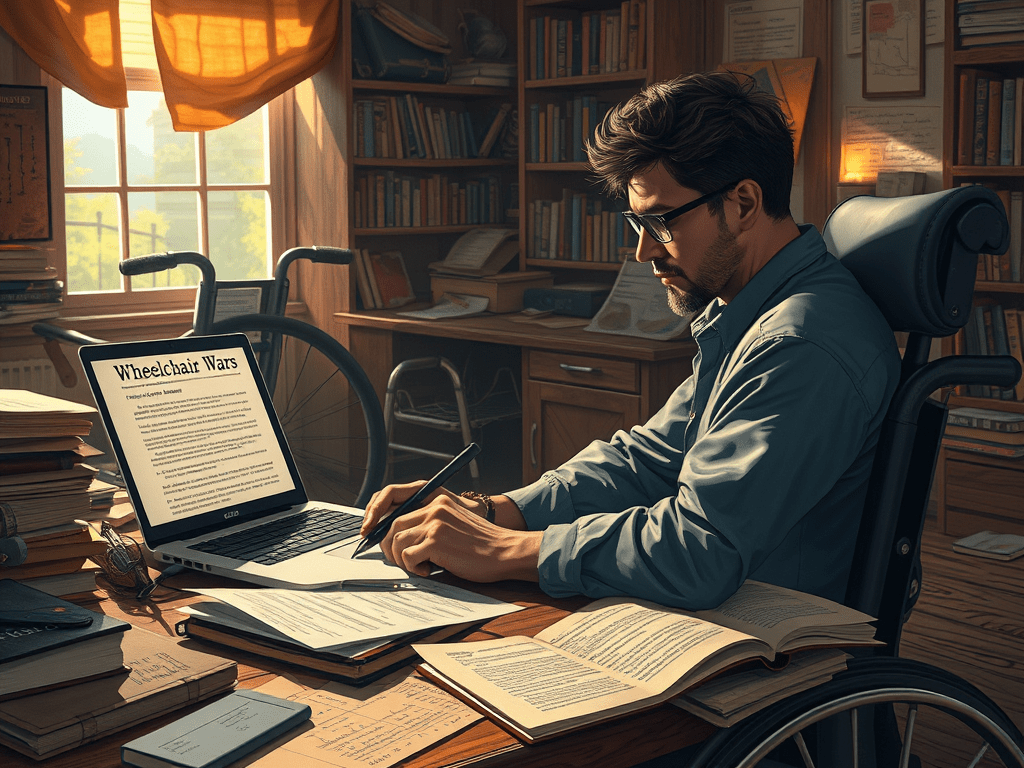
Wheelchair Wars: I have sent this to a professional editor. Hoping to have it published this year. This project has me really excited.

Romance Short Stories: I’m hoping to finish editing in 2-3 months. It will probably then be sent to a professional.

Pegasus: Editing has yet to begin.

Long Distance Love: About 40% of the first draft is complete.

Just a reminder about the novels I currently have for sale on Amazon: The Irish Ripper, Not the Usual Suspect, Paradigm, and Chronicles of Martan.

I feel that things are really progressing at the moment. This has been my best-ever January for views. All feedback is greatly appreciated.

Distant Love (Part 60)

Then he clicks on the icon.

Derek: Sorry, Maeve, I’ve been crazy busy at work. Haven’t had time to check out Darko World recently. Hows my fortress going?

Maeve: That’s been overrun for quite some time. All nobles were slaughtered.lol You should have told me. I would have kept things ticking over for ya. You know, for a fee, like.

Derek: Oh, I don’t know if I could afford you.

Maeve: Don’t be silly. Seriously, I’ve missed you. The parents are up my ass as per usual. You are the only person I feel like I can really talk to. You know you’re my only.

Derek’s heart races. He looks around his office, devoid of life or meaning.

To hell with it.

Derek: I feel the same way. And we will meet someday.

Maeve: I know. Actually, I might be in your space region in a few weeks. My Mum was saying she has an important cargo to bring to lunar orbit. Probably just more old people.Pity I can’t jump off the ship to meet you.

Derek: It would be cool, though. Soz, have to get back to work.

Derek would have liked to stay chatting, but his screen flashed.

A ship was looking to land in his quadrant.

Be terrified of The Devil in Disguise: John Gacy

For those of my readers with a stronger disposition, I came across this docuseries that may be worth giving a watch. Beware, though, it can be horrific at times.

Devil in Disguise: John Wayne Gacy is an eight-episode, American true crime drama miniseries that premiered on October 16, 2025, on Peacock. You can currently watch it on RTE Player for those in Ireland. It dramatizes the life and crimes of serial killer John Wayne Gacy, who murdered dozens of young men and boys during the 1970s.

is a gripping and deeply unsettling docuseries that stands out for its thoughtful storytelling and emotional depth. Rather than simply recounting shocking crimes, the series carefully explores how John Gacy was able to hide behind a façade of normalcy, offering a chilling insight into the psychology of deception and the failures that allowed his crimes to go unnoticed for so long.

The pacing is excellent, balancing suspense with clarity, and the use of archival footage, interviews, and expert commentary feels both respectful and impactful. Particularly powerful are the perspectives of investigators and those affected by Gacy’s actions, which add a human dimension that elevates the series beyond typical true-crime narratives.

Michael Churnus gives a great performance as John Gacy, displaying all the traits that helped him evade capture. I was particularly fascinated by how he could talk himself out of getting caught.

I give it four stars out of five. You have been warned.

Exploring 1975’s Cinematic Revolution

For those of readers interested in the history of films and how it can be a reflection of what is happening in society, this is an interesting watch. Breakdown: 1975 is a 2025 Netflix documentary by Morgan Neville exploring how a turbulent mid-70s America, marked by Watergate, Vietnam’s end, and economic woes, inspired a cinematic renaissance, leading to iconic films like Taxi Driver and One Flew Over the Cuckoo’s Nest, featuring insights from figures like Martin Scorsese and Jodie Foster. It examines 1975 as a peak year for character-driven cinema reflecting societal disillusionment, a “nervous breakdown” moment for the country.

The premise is that studios no longer knew what worked, as the population had become disillusioned. Westerns and musicals no longer cut it. The world was no longer black and white but grey. Movie makers were given much greater freedom leading to a burst of creativity.

Other classics from that one year include :

Dog day afternoon (Surely, the definition of anti-establishment)

Nashville

Monty Python and the Holy Grail

The Stepford Wives

Rollerball.

It was great while it lasted. But nothing lasts forever. Jaws was released and the time of the blockbuster had arrived.

Four stars out of five from me.

Why Dune is a Must-Read for Sci-Fi Fans

I finally did it, I read the novel Dune, written by Frank Herbert and originally published way back in 1965. It’s a significant feat, at one hundred and eighty thousand words. And every page was worth it! It’s one of the best-selling science fiction novels of all time.

Dune is set in the distant future in a feudal interstellar society, descended from terrestrial humans, in which various noble houses control planetary fiefs. It tells the story of young Paul Atreides, whose family reluctantly accepts the stewardship of the planet Arrakis. While the planet is an inhospitable and sparsely populated desert wasteland, it is the only source of melange or “spice”, an enormously valuable drug that extends life and enhances mental abilities. Melange is also necessary for space navigation, which requires a kind of multidimensional awareness and foresight that only the drug provides. As melange can only be produced on Arrakis, control of the planet is a coveted and dangerous undertaking.

This is one of those rare novels that feels vast without ever losing its grip on the reader. From the opening pages, Herbert immerses us in the harsh deserts of Arrakis, a world where sandworms rule, water is sacred, and politics are as deadly as the climate. The setting is not just a backdrop but a living system, intricately tied to culture, religion, economics, and power. Few science fiction novels build a universe that feels this coherent, purposeful, and alive.

The level of detail does mean it can be a hard slog at times, but I became increasingly engrossed. As a writer of science fiction myself, reading the novel spoke to me about the immense importance of world-building and that even minute details are important.

The political intrigue is equally gripping. The power struggle between House Atreides, House Harkonnen, and the Emperor unfolds with the complexity of a grand historical drama. Herbert trusts his readers, refusing to over-explain, and instead allows meaning to emerge through dialogue, internal monologue, and carefully placed details. This approach rewards close reading and makes the world feel ancient and layered, as if the events of the novel are just one chapter in a much larger history.

Herbert’s treatment of ecology was remarkably ahead of its time. Arrakis is a planet shaped by scarcity, and the Fremen’s intimate understanding of their environment is portrayed with deep respect. The idea that an ecosystem can be deliberately transformed—and that such transformation carries cultural and moral costs—feels strikingly modern. The sandworms, the spice melange, and the planet’s fragile balance form one of the most memorable and meaningful ecological systems in all of science fiction.

Ultimately, Dune endures because it combines epic storytelling with serious ideas, without sacrificing tension or wonder. It is a novel that challenges the reader as much as it entertains, offering action, mysticism, and political drama while quietly probing the dangers of power and prophecy. More than sixty years after its publication, Dune remains not just a cornerstone of science fiction, but a profound and unsettling meditation on the future of humanity itself.

Five stars out of five from me.

Distant Love (Part 59)

Derek moves his mouse this way, then that way. Anything to keep his mind occupied. There are only a few dots in orbit around the moon for him to worry about. It has been a boring shift. It’s been six Earth days since he met Lulu, and it is now in the middle of the lunar night in his part of the rock. There are only the stars and a distant Earth outside the habitat.

He longs for Earth to breathe natural air and to see its diverse landscapes.

An icon in the bottom-right corner of his screen flashes, with the name Maeve appearing in Times Roman above. His heart beat faster; he had been hesitant to contact her after Lulu, but now had no choice. He couldn’t afford to be seen as not complying with a request from the Lunar Police.

He clicks on the icon.

  • Hi Derek, how have you been? You haven’t been on Darko World recently. I’ve missed our chats.

Derek taps his fingers against the table.

What should I do? Maeve wouldn’t hurt a fly, but her family must be very different. All I know is that I care about her. I’m not going to let them lock her up and throw away the key,

|

Why You Need to Watch The Rip Right Now!

My dear readers, I have an urgent message for you. Stop whatever you are doing, subscribe to Netflix or a dodgy box, and watch The Rip. Quite simply, it is that good. An easy five stars out of five, and the best gangster type film I’ve seen in years.

The Rip is a 2026 American action thriller film written and directed by Joe Carnahan, who developed the story with Michael McGrale. The film stars Matt Damon and Ben Affleck as police officers within the narcotics unit of the Miami-Dade Police Department. They give stellar performances. It also stars Steven Yeun, Teyana Taylor, Sasha Calle, Catalina Sandino Moreno, Scott Adkins, and Kyle Chandler.

It is inspired by the true story of Miami-Dade County Sheriff Chris Casiano. This film tells the story of a group of police officers who, during a raid on a hidden cash operation, find their trust broken down as team members suspect each other of trying to steal a large sum of cash.

The Rip is a gripping, confidently made film that lingers long after the credits roll. From its opening moments, it establishes a tense, immersive atmosphere and never lets go, pulling the viewer into a story that feels both intimate and unsettling. The film’s greatest strength lies in how controlled and purposeful it is—every scene, every beat, feels intentional.

The performances are a standout across the board. The cast delivers raw, believable work that grounds the film’s more intense moments in genuine emotion. Rather than relying on exaggerated reactions, The Rip allows its characters to unravel in subtle, human ways, making their choices and consequences feel painfully real. This emotional restraint makes the film’s most powerful moments hit even harder.

Visually, The Rip is striking without being showy. The cinematography uses framing, lighting, and movement to reinforce the story’s themes, often communicating more through silence and composition than dialogue ever could. The film has a strong sense of place, and the environment itself becomes part of the storytelling, heightening tension and reinforcing the characters’ inner turmoil.

It is all brought to a well-thought-out and masterful conclusion. No need to thank me. Start Netflixing.

Exploring Horror and Music in Sinners: A Unique Film Review

Hello, my dear readers. Are you in the mood for some horror? I certainly was last Sunday, when I watched Sinners.

Set in 1932 Mississippi, Sinners follows twin brothers Smoke and Stack Moore (both played with stunning nuance by Michael B. Jordan) as they return to their hometown with dreams of opening a juke joint and leaving behind their troubled pasts. They seem to have made it big, splashing their cash at the locals. And they have big dreams.

This period drama was the part of the film I liked the most. I love films from this period, and it was covering a part of the US that I had not witnessed before. It showed the harshess of their environment as they clung to existence.

Then the horror starts. Irish immigrant vampire Remmick shelters from Choctaw vampire hunters with a married Klansman couple, whom he turns into vampires. They are attracted to the Duke joint on its opening night.

One of the things that makes this horror unique is the use of music not just as accompaniment but as a narrative force. Blues sequences aren’t just evocative backdrops — they become conduits for emotion, cultural memory, and even supernatural influence.

There is a lot I like about this film, but the vampires’ behavior was erratic, making it seem too silly at times.

I give the film three stars out of five.