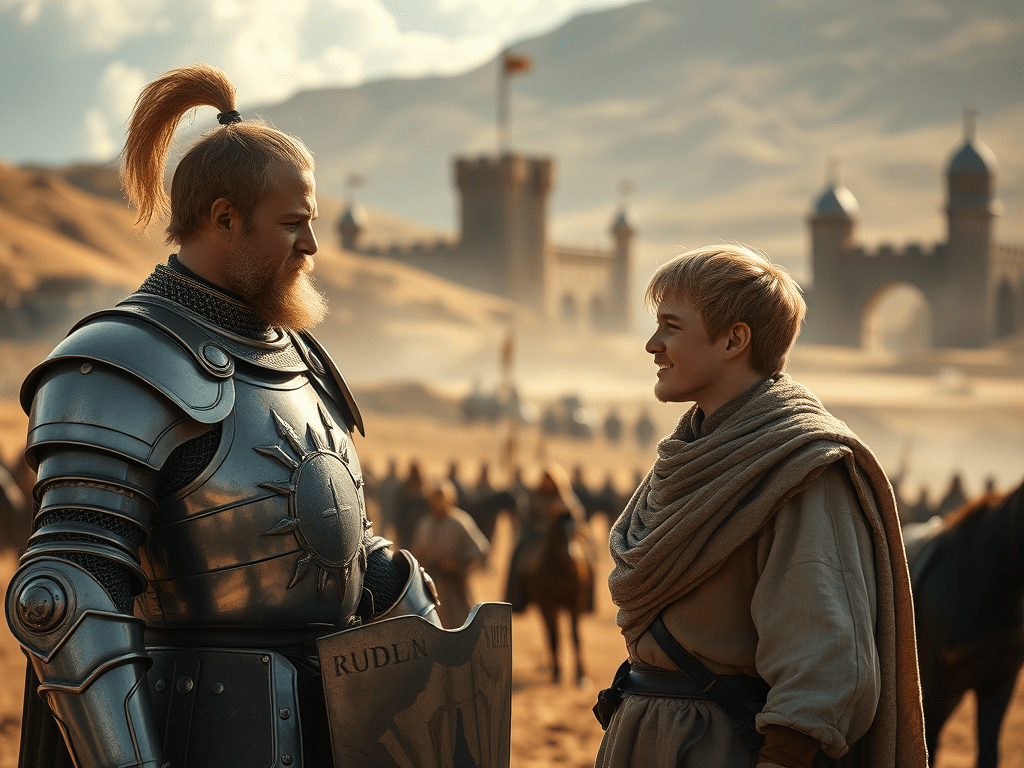
A Knight of the Seven Kingdoms: Stunning Visuals and Storytelling

My dear readers, I have currently watched the first three episodes of A Knight of the Seven Kingdoms. It’s a slow burner but it’s growing on me. It is a captivating return to the world of Westeros, offering a refreshing, character-driven story that proves the Game of Thrones universe (it is set one hundred years prior to the last series) still has rich tales left to tell. Rather than relying on massive battles and political spectacle alone, the series shines through its intimacy, emotional depth, and timeless sense of adventure.

Created by Ira Parker and George RR Martin, it is the third television series in Martin’s A Song of Ice and Fire franchise and is an adaptation of the Tales of Dunk and Egg series of novellas, beginning with The Hedge Knight. It stars Peter Claffey as Ser Duncan “Dunk” the Tall, the titular hedge knight, and Dexter Sol Ansell as his squire Aegon “Egg” Targaryen.

At the heart of the story is the unlikely duo of Ser Duncan the Tall and his sharp-witted squire, Egg. Their relationship is the soul of the series—warm, humorous, and deeply human. Duncan’s sincerity and moral compass contrast beautifully with Egg’s intelligence and hidden nobility, creating a dynamic that feels both authentic and endearing. Watching their bond grow across each episode is as rewarding as any grand plot twist.

Visually, A Knight of the Seven Kingdoms is stunning. The cinematography captures the beauty and brutality of the medieval-inspired landscapes with remarkable detail. From dusty tournament fields to quiet country roads and imposing castles, every setting feels alive and immersive. The production design and costumes further enhance the authenticity of the era, grounding the fantasy in a tangible, believable world. Of particular note, the scenery is from Northern Ireland.

So far, I give it four stars out of five and was happy to hear its getting a second series. I just hope that the ending is better than Game of Thrones.

A Deep Dive into Arthur C Clarke’s Childhood’s End

Well, readers, I have a treat for you today after I completed the above novel that was written in nineteen fifty-seven by what is considered to be one of the best science fiction writers of all time. This is considered by most to be his greatest work.

First, a description from Wikipedia (in italics) that I’ve read and agree with.

In the late 20th century, the United States and the Soviet Union are competing to launch the first spacecraft into orbit when alien spaceships suddenly position themselves above Earth’s principal cities. After one week, the aliens announce they are assuming supervision of international affairs, to prevent humanity’s extinction. They become known as the Overlords. In general, they let humans go on conducting their affairs in their own way, although some humans are suspicious of the Overlords’ benign intent, as they never allow themselves to be seen.

Yeah, remember the Soviet Union? They were a big deal back then.

The Overlord Karellen, the “Supervisor for Earth”, periodically meets with Rikki Stormgren, the Secretary-General of the United Nations. Karellen tells Stormgren that the Overlords will reveal themselves in 50 years, when humanity will have become used to their presence. When the Overlords finally reveal their appearance, they resemble the traditional Christian folk images of demons, with cloven hooves, leathery wings, horns, and barbed tails. Humankind enters a golden age of prosperity at the expense of creativity.

The Overlords are interested in psychic research, which humans suppose is part of their anthropological study. Rupert Boyce, a prolific book collector on the subject, allows one Overlord, Rashaverak, to study these books at his home. To impress his friends with Rashaverak’s presence, Boyce holds a party, during which he makes use of a Ouija board. Jan Rodricks, an astrophysicist and Rupert’s brother-in-law, asks the identity of the Overlords’ home star. The Ouija board reveals a number which Jan recognizes as a star-catalogue number and learns that it is consistent with the direction in which Overlord supply ships appear and disappear. Jan stows away on an Overlord supply ship and travels 40 light years to their home planet.

The story then continues to reveal that humans are about to make a psychic leap, which will elevate humanity to a new level of existence, allowing it to join the Overmind, but also lead to the end of humans as an independent race.

So what did I think? Well, it was interesting what the author conceived a future alien species would be like. There is no advanced robotics, and only a brief mention of computers that can do wondrous things. Although they are still described as mostly mathematical tools.

Credence is given to the supernatural. This is something that the author quasi-believed at the time but later disavowed. Still, it helps the story come along.

The character development and writing are of the highest quality, and it is refreshing to read something from a nineteen-fifties perspective. You should give it a read.

On a more negative level, the passing of time shows. So, you have to put things we know now out of your mind and use some imagination.

Overall, I’d give it four stars out of five.

Remember to subscribe if you like my content, and chat with you all again soon.