
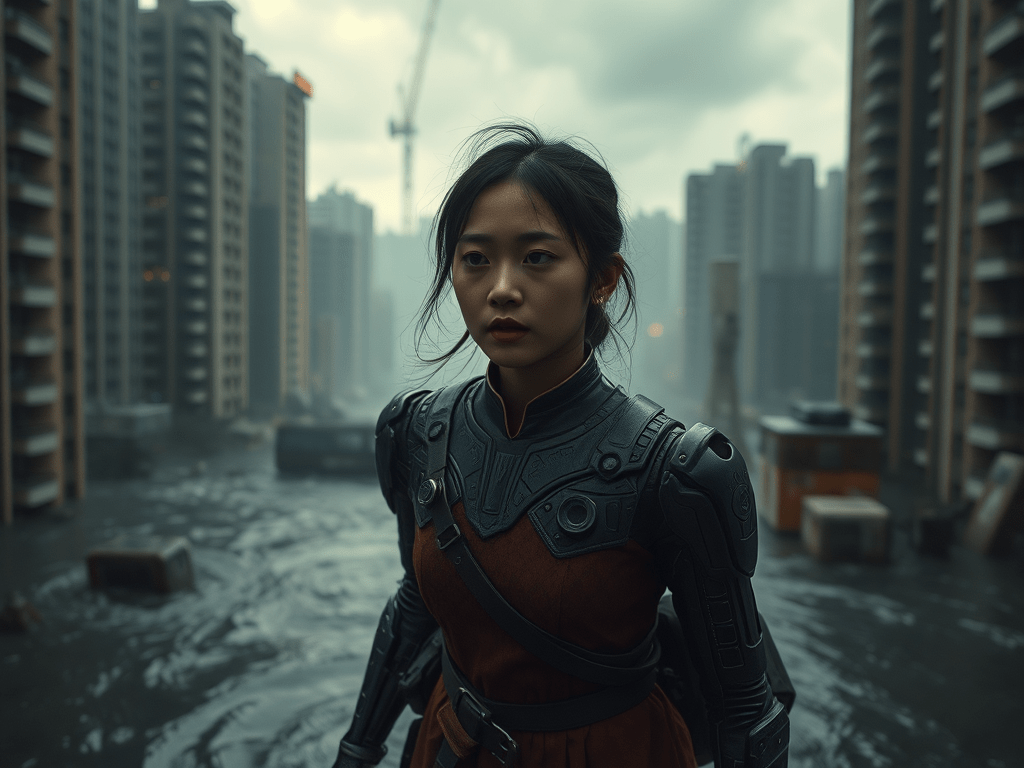
One of the best things about Netflix is that you get to watch films and documentaries from all over the world. One such film is The Great Flood from South Korea. It was co-written and directed by Kim Byung-woo.
An-na, an AI researcher and recent widow, played by Kim-Da-mi, wakes in her apartment to find floodwater rising in the thirty-floor complex. With her six-year-old son Ja-in, she attempts to reach safety.
However, they are no ordinary mother and child. The child is a robot designed to experience emotion. This is critical to the whole film. An asteroid has hit, and human extinction is imminent. World governments knew what was going to happen and funded secret efforts to survive, including a space station and research into the creation of engineered human bodies and consciousness. An-na’s employer is also revealed to be involved in these projects, putting her and her child central to humanity’s future.
What stands out most is the film’s balance between scale and humanity. While the flood itself is rendered with striking visual power—ominous skies, rising waters, and carefully staged moments of chaos—the story never loses sight of the people caught within it. The narrative lingers on personal choices, moral dilemmas, and quiet acts of courage, allowing the disaster to feel not just catastrophic, but deeply personal. This focus gives the film an emotional weight that elevates it beyond a standard disaster movie.
The performances are uniformly strong, grounded, and convincing. Rather than leaning into melodrama, the actors bring restraint and authenticity, making fear, grief, and resilience feel earned. Small gestures and silences often speak louder than dialogue, and those understated moments are some of the film’s most powerful.
Technically, The Great Flood is impressively crafted. The cinematography captures both the beauty and menace of nature, using light, color, and movement to heighten tension. The sound design is particularly effective—the rush of water, distant alarms, and sudden quiet all work together to create a visceral experience that keeps the audience on edge. The pacing is deliberate, allowing suspense to build naturally while still delivering moments of urgency and release.
Ultimately, The Great Flood is a film about survival in the broadest sense: not just surviving a natural catastrophe, but preserving compassion, responsibility, and hope when everything familiar is threatened.
If nothing else, it is a great story. With AI coming to the forefront of our lives, I expect more films of this nature in the future. Four out of five stars from me.


 Mark's Writing Corner