
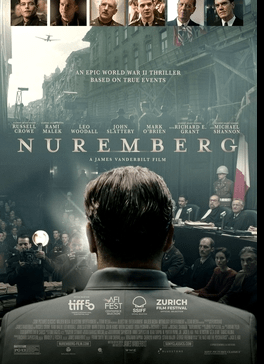
Not for the faint-hearted, this film is currently being shown on Sky Movies. Nuremberg (2025) is a compelling and meticulously crafted film that succeeds both as a historical drama and as a deeply human exploration of justice, morality, and responsibility. From its opening moments to its final, reflective scenes, the film commands attention with quiet confidence and emotional weight.
One of the film’s greatest strengths is its restrained yet powerful storytelling. Rather than relying on spectacle or melodrama, Nuremberg allows tension to build through dialogue, performance, and ethical confrontation. The screenplay is intelligent and precise, presenting complex legal and moral questions in a way that feels accessible without ever being simplistic. The pacing is deliberate, giving viewers time to absorb the gravity of the events while remaining consistently engaging.
Nuremberg is a 2025 American psychological thriller historical drama film written, co-produced, and directed by James Vanderbilt. Based on the 2013 book The Nazi and the Psychiatrist by Jack El-Hai, the film follows U.S. Army psychiatrist Douglas Kelley (Rami Malek) seeking to carry out an assignment to investigate the personalities and monitor the mental status of Hermann Göring (Russell Crowe) and other high-ranking Nazis in preparation for and during the Nuremberg trials. Leo Woodall, John Slattery, Mark O’Brien, Colin Hanks, Wrenn Schmidt, Lydia Peckham, Richard E. Grant, and Michael Shannon have supporting roles in the film.
Russell Crowe, in particular, gives a breathtaking performance as Hermann Göring. The back and forth of his testimony is the central plank of the film.
Visually, Nuremberg (2025) is striking in its understatement. The cinematography favors muted tones and carefully composed frames, reinforcing the somber atmosphere without feeling oppressive. Production design is detailed and immersive, effectively transporting the audience to the post-war setting while maintaining a grounded, realistic feel. The score is used sparingly but effectively, enhancing emotional moments without overwhelming them.
What truly elevates the film is its thematic depth. Nuremberg does not simply recount historical events—it invites reflection on accountability, the rule of law, and the enduring consequences of moral choices. The film resonates strongly in a modern context, reminding viewers why truth, justice, and ethical responsibility remain essential values. Its relevance feels intentional and timely, adding an extra layer of significance to the viewing experience.
In the end, Nuremberg (2025) stands out as a thoughtful, mature, and deeply respectful film. It is not only an important historical portrayal but also a gripping cinematic experience that lingers long after the credits roll. Powerful without being preachy and emotional without being manipulative, it is a film that rewards careful attention and thoughtful reflection. Highly recommended for audiences seeking intelligent, meaningful cinema.
The film gets five stars out of five from me. Beware, there are some horrific images from the concentration camps in the film.
Have you seen it? Let me know in the comments.
 Mark's Writing Corner